
On August 15, 1965, the Beatles walked onto a makeshift stage at Shea Stadium in New York and played to 55,600 screaming fans. It was, by most accounts, the first true stadium rock concert in history. No one had built speakers loud enough for a crowd that size. The band couldn’t hear themselves play. There was no rulebook, because nothing like this had been tried before.
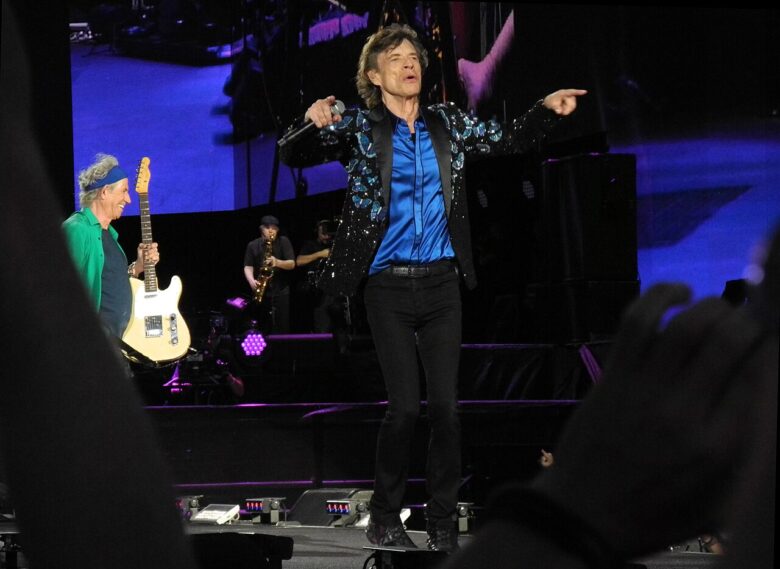
Sixty-one years later, some of the people who were there at the start are still on the road. Mick Jagger is 82. Bob Dylan is 84. Ringo Starr is in his mid-80s and still booking full touring bands, not just one-off cameos. This isn’t a victory lap. It’s still real touring, at a scale and age no one in the history of the format has ever reached.
That raises a question most of the coverage of “aging rock stars” skips past. It’s not just why they keep going. It’s whether they are watching the entire era close, in real time, with no one clearly positioned to take their place.
They Didn’t Inherit the Job. They Built It.
Before the 1960s, popular musicians toured differently. Big-band singers like Frank Sinatra crossed the country by bus, playing ballrooms and theaters. In the early 1950s, rock and roll shows were mostly package tours: a rotating lineup of acts, each playing a couple of songs, none of them the main event.
The stadium show, the model that still defines a “big” tour today, didn’t exist until the Beatles created it almost by accident. Their popularity had outgrown theaters and arenas, so promoters moved them outdoors, into ballparks. The Rolling Stones followed almost immediately. So did the Who, and later Led Zeppelin and Pink Floyd. By the 1970s, stadium touring was standard practice for any band big enough to fill one.
This matters because it means the artists now in their 80s weren’t handed a career template. They wrote it. There was no earlier generation of stadium rock stars for them to study, because they were the earlier generation. Whatever “growing old on the road” looks like, they are the first people ever to try it inside this particular format.
A Test With No Prior Results
Right now, that test is producing real, current answers, and some of them are not simple triumphs.
The Rolling Stones scrapped a planned 2026 stadium tour of the U.K. and Europe. According to reporting from Parade, the reported reason wasn’t ticket demand or scheduling. It was that Keith Richards could not commit to the physical demands of a multi-month run. The band, a live institution for six decades, is not immune to the thing everyone eventually runs into.
Dylan offers a different kind of data point: pure duration. His Never Ending Tour began in 1988 and has continued, with only brief pauses, for nearly forty years. No other major touring act has attempted anything close to that length of continuous work. It is less a tour than a way of life, and Dylan is still doing it in his mid-80s.
And then there’s Ringo Starr, whose approach is the most old-fashioned in the best sense. Rather than making sporadic guest appearances, he still assembles a full touring band, called the All Starr Band, and commits to real dates on a real schedule. It’s a version of the job that looks almost unchanged from 1965, just performed sixty years later by someone in his mid-80s.
Trade groups have started to name this moment. AARP’s own touring guide for 2026 describes acts like Dylan and Santana, most born between 1944 and 1954, as leading what it plainly calls “boomer tours.” The framing has become mainstream enough that a retirement-focused publication is now covering it as a beat.
Why the Next Generation May Not Get the Chance
Here is where the story gets more interesting than the usual “they just love the road” explanation. There are real, structural reasons to think this specific pattern may not repeat.
The first is about the music itself. Guitar, bass, drums, and one voice is a format that bends easily with age. A band can play quieter, slower, shorter, and still deliver the songs people came for. Later genres don’t have that flexibility built in. Pop and hip-hop acts depend heavily on dancing, elaborate staging, and vocal ranges that are much harder to preserve into old age. It’s not obvious that a show built around choreography and spectacle can simply be scaled down the way a rock band can.
The second reason is economic. Legacy and nostalgia tours are now one of the most profitable corners of live music. Industry research shows older fans attend fewer shows overall than younger ones, but they spend heavily and consistently on the artists tied to their own youth. That’s a real business model, but it exists largely because streaming has gutted income from recorded music for exactly this generation’s catalog, pushing them onto the road as their main source of income. Whether that same financial pressure and audience loyalty will exist for artists whose careers were built entirely inside the streaming era is genuinely unclear.
The third reason is simpler: no one has tested it yet. The music journalist David Hepworth wrote an entire book on why rock stars from this era keep going, arguing that a career built on live performance, rather than a salary, naturally resists the idea of retirement. That may be true. But it’s also true that Hepworth, like almost everyone writing about this subject, is describing a pattern with a sample size of one generation. We don’t actually know if Dave Grohl, Beyoncé, or Kendrick Lamar will still be selling out stadiums in their 80s, because nobody born after 1960 has lived long enough, in a music career, to find out.
The Beginning and the End, at the Same Time
It’s tempting to read the current wave of octogenarian touring as proof that age no longer matters in rock and roll, that retirement itself has become optional. But it may be closer to the opposite. This may be a single, unrepeatable generation, standing at both ends of its own story: the people who happened to invent the modern touring era at the exact moment they were young enough to build it, and who are now, by accident of timing, the only ones old enough to find out what happens when a stadium-rock career runs all the way to the end.
Whether anyone gets to follow them is not something we can answer yet. For now, the same people who filled Shea Stadium in 1965 are still the ones filling stadiums six decades later. They weren’t just early. They may turn out to be the only ones who ever get to stay this long.